industrial, machinery and appliance spare parts / Buying guide
Obsolete machine parts
Last updated
A discontinued part is not a manufacturing problem. Almost any mechanical component can be remade — the geometry is knowable, the material is identifiable, and the machining capacity exists in quantity. It is a sourcing problem: finding a shop that will take a quantity of one and hold the tolerance that matters.
The parts of the job that go wrong are the ones where nobody wrote down which dimension was critical.
In this guide
What can be remade, and what cannot
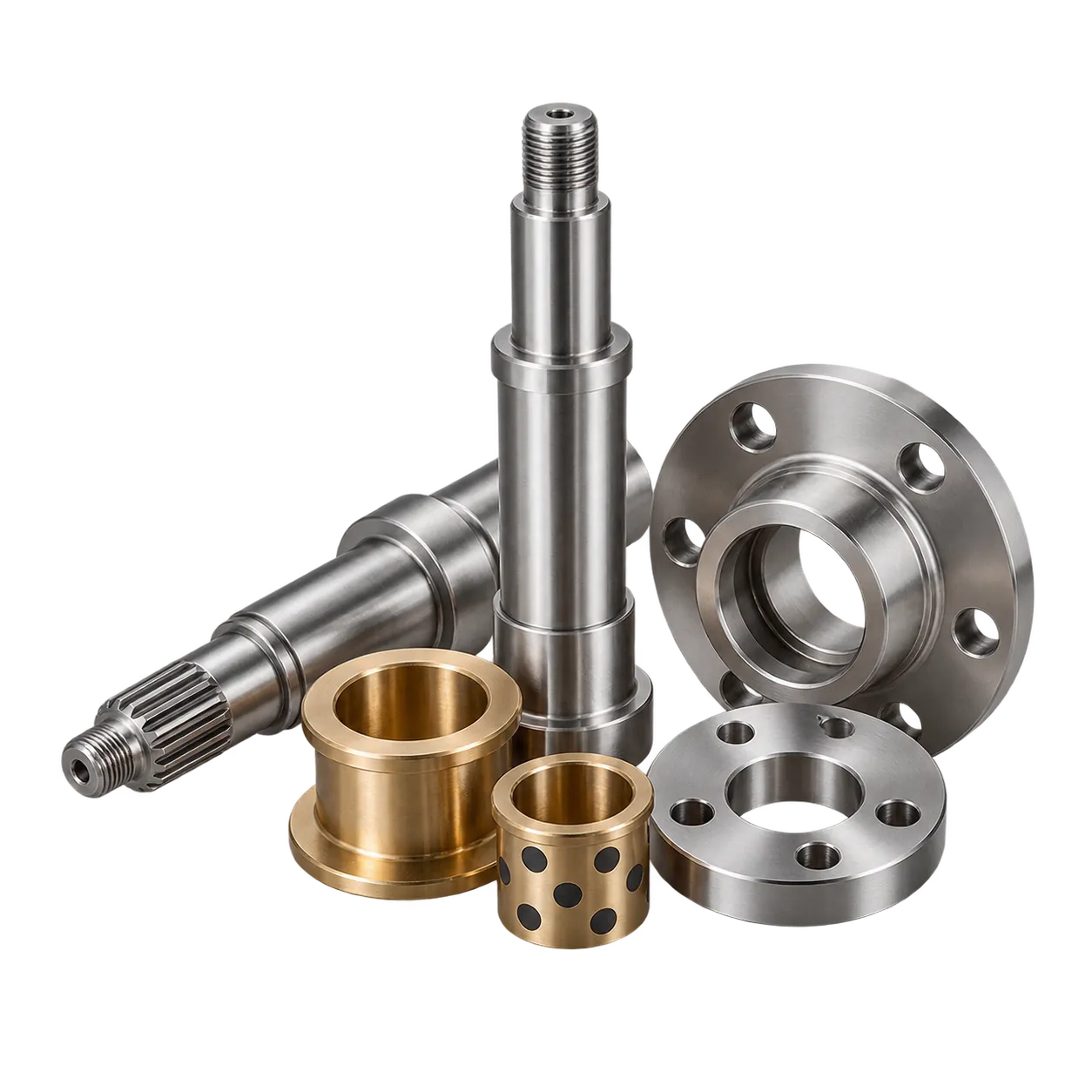
- Machined metal parts — shafts, bushings, bearings housings, gears, brackets. Routine.
- Cast and then machined parts — housings, manifolds, pump bodies. Needs a pattern, so it needs volume or a tolerance for cost.
- Moulded plastic and rubber — seals, gaskets, bushings, covers. Needs tooling; below a few hundred pieces, 3D printing or machining from stock is cheaper.
- Electronic assemblies and control boards — rarely worth remaking. Look for a functional replacement or a repair specialist instead.
- Anything with a safety certification attached — pressure vessels, lifting components, anything with a stamped rating. Remanufacturing these transfers the certification liability to you.
What a shop needs from you
In descending order of usefulness: the original drawing; a CAD model; a physical sample; photographs with a scale reference plus measured critical dimensions.
A sample is better than photographs by a wide margin, because it can be measured directly and reverse-modelled. Send the broken one — a failed part still carries every dimension except the one that failed.
The specification that has to be agreed in writing
- Material and grade, not just "steel" or "aluminium".
- Heat treatment and hardness, with the target and the acceptable range.
- Which dimensions are critical and to what tolerance. Everything cannot be critical, and if you say it is, you will pay for it.
- Surface finish where it matters — bearing surfaces, sealing faces.
- Coating or plating, and its thickness.
When this is the wrong answer
When a functionally equivalent standard part exists. Bearings, seals, fasteners and belts are made to international standards; look up the standard designation before commissioning a copy of a proprietary one.
When the part is cheap and available with a long lead time and the machine is not critical. Waiting is often cheaper than tooling.
When the failure keeps recurring. A part that fails repeatedly is usually a symptom, and remaking it faster just means failing it faster.
Questions & answers
Common questions
- Can you make one piece?
- For machined parts, yes — the setup dominates the cost, so one is expensive per unit but possible. For moulded or cast parts, tooling makes a single piece uneconomic and machining from solid is usually the better route.
- How long does it take?
- A machined one-off is typically 2–4 weeks including sampling. Anything needing tooling is 6–10 weeks. Air freight after that.
- What if I only have the broken part?
- That is usually enough. Send it — the missing geometry can normally be inferred, and we will tell you plainly if it cannot.
Your next step
Have a link you want checked?
Send a 1688 or Taobao product link and you get back the specification in English, the supplier check, and the landed cost to your country before you commit to anything.
Get a quote