
Custom Spring Freight Budgets: Use the Agreed Shipment Quantity Range
Budget the agreed shipment quantity range before treating a custom spring order quantity as the final freight input.
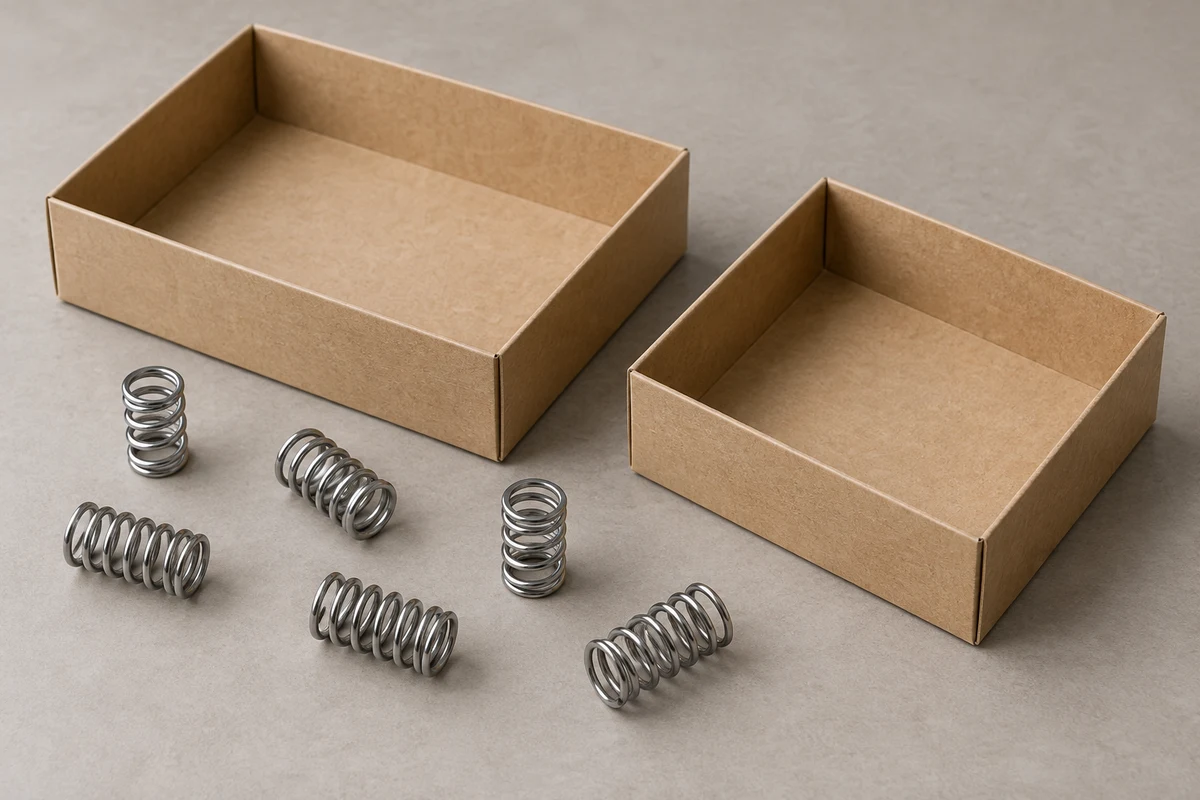
For a custom spring order, distinguish the quantity requested from the quantity the supplier is permitted to ship. If an agreed production term allows an overrun, the goods bill and packing record may need a range before production. A freight estimate built only on the nominal order quantity can conceal that exposure.
The useful discussion takes place before order release. Ask the supplier and the buyer's requirement owner to resolve the shipment quantity basis, then ask for packing and transport estimates against that basis. This does not decide whether surplus springs are useful or establish a universal manufacturing tolerance.
Separate the order quantity from permission to ship more
Lee Spring's conditions of sale, under Production Standards, state that quantity tolerances up to 10% overshipment are acceptable to seller and buyer. That named supplier's published provision makes quantity a concrete enquiry point; it is not a rule to impose on another supplier or proof of the terms governing a particular purchase.
Ask which quantity provision the actual quotation incorporates and whether a different limit has been expressly agreed. Preserve the supplier's acknowledgement. Writing a requested quantity in an internal requisition does not resolve a different provision in the accepted offer.
Keep any permitted overrun separate from a forecast. Permission to supply extra units does not mean those units will be produced, shipped or accepted as conforming. Do not present the maximum as confirmed stock or use it to reduce another order before actual supply is established.
Establish how goods would be billed
Request the actual charge basis for each allowed quantity. Does the provider quote a fixed total, a unit amount applied to the shipped quantity or another defined arrangement? Record the answer rather than assuming all permitted additional pieces are free or billable under the nominal unit price.
If the buyer cannot use extra approved springs, say so while terms can still be discussed. Quantity control is a procurement requirement, not a reason to change the spring specification or silently count surplus as useful inventory. Any proposed technical alternative needs its own responsible review.
Separate engineering tolerances from commercial quantity tolerance. A permission to ship more units does not relax dimensions, material, manufacturing state or acceptance requirements for any of them.
Quote the packing states that could result
Ask the supplier how the authorized quantity range affects units per inner pack, master-carton count and final packed measurements. Do not multiply nominal freight by the percentage overrun. A few more pieces may fit in existing capacity or require a further package; only the proposed packing evidence can answer that.
Provide the actual logistics service with the supported scenarios and ask for comparable estimates. Preserve what remains provisional until packing is complete. The objective is to identify a possible change in chargeable quantity or shipment scope, not to invent a surcharge for every extra spring.
Quantity-range worksheet
| Input | Evidence needed before commitment |
|---|---|
| Required springs | Exact approved reference and useful requirement |
| Requested order | Nominal quantity in the purchasing record |
| Allowed shipment | Supplier-acknowledged limit or unresolved term |
| Goods charge | Actual billing rule for nominal and additional units |
| Packing scenarios | Supplier's package counts and measurements at relevant quantities |
| Freight estimate | Provider's scope and calculation basis for each scenario |
| Final reconciliation | Shipped quantity and actual packed record before dispatch |
This table tracks commercial inputs. It does not grant permission for an overrun or establish any spring's conformity.
Fictional example: one more inner pack
Suppose a fictional order requests 100 approved custom springs and the acknowledged terms permit up to 110. These are illustrative quantities, not an order or a recommended tolerance. The buyer's freight worksheet originally assumes ten inner packs of ten.
The buyer asks whether 110 would create an eleventh inner pack and whether the outer packing would change. If that answer is unknown, the upper freight estimate remains open. If the supplier provides an actual second packing proposal, the logistics provider can price it without pretending that a 10% unit increase means a 10% transport increase.
The buyer also checks whether its approved budget covers the stated goods-charge rule. Before dispatch, the final quantity replaces the planning scenario while the original estimate remains available to explain the difference. A permitted range supports planning; only the actual ready-goods record supports the final shipment instruction.
Bring a defined question to the supplier
See Spareparts product context for the relevant buying category. Use the Spareparts sourcing enquiry to describe the exact item and unresolved commercial question. Spareparts provides independent aftermarket and unbranded buying coordination and supplier negotiation. The named manufacturers are documentary examples, not affiliations or a claim that Spareparts supplies their branded products or services.
Frequently asked questions
Does a 10% overrun mean freight rises by 10%?
No. Extra pieces can change packing and chargeable quantities differently. Obtain the supplier's actual packing scenarios and the transport provider's corresponding calculation.
Are additional springs automatically free?
No such term is established. Confirm the actual goods-billing rule and record it alongside the allowed shipment quantity.
Can I count the maximum quantity as inbound stock?
Not merely because an overrun is permitted. Keep the upper quantity as a planning scenario until the actual commitment and shipped quantity are supported.
Does quantity tolerance relax product specifications?
No. Treat commercial shipment quantity and technical acceptance requirements separately. A permitted extra piece still needs to meet the applicable approved requirement.
Sources
Discuss a sourcing request related to this article.Custom Spring Freight Budgets: Use the Agreed Shipment Quantity Range