
Disc-spring receipt: review a construction change against the approved stack
Review a delivered bearing-surface and reduced-thickness construction against the approved parallel-stack envelope before treating an explanation as acceptance.
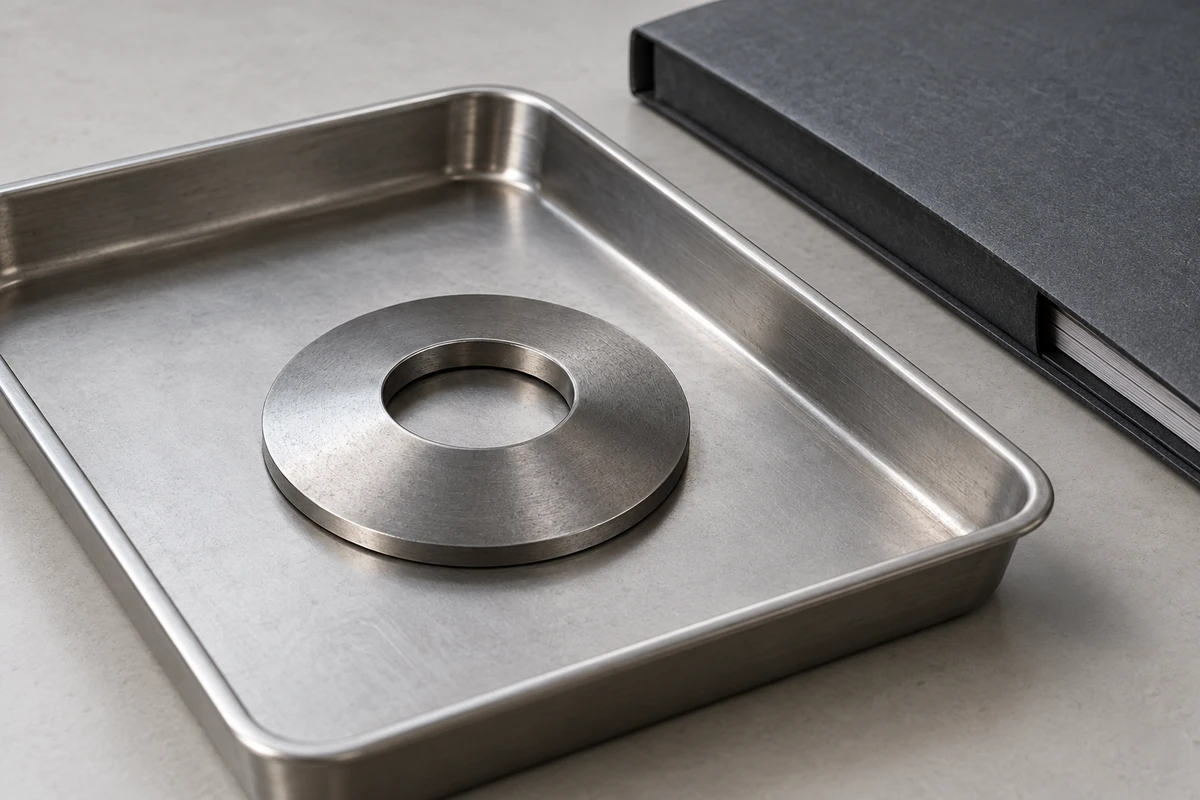
Imagine a supplier confirming that the delivered disc springs use turned bearing surfaces and intentional reduced thickness, while the accepted record for an existing parallel stack specifies a different construction. The explanation may account for the delivered geometry. It does not establish that the change is authorized for that stack.
The receipt decision is whether the delivery represents the already approved construction, a construction change requiring disposition, or a comparison that cannot yet be made because the assembly baseline is missing. Assume the received items, measured feature and report identity have already been established. The remaining question is what the construction means for the approved assembly envelope.
Why the existing parallel stack matters
SCHNORR's product brochure describes its group 3 disc springs as having turned bearing surfaces and reduced thickness. It explains that the bearing surfaces increase force and that reduced thickness t′ compensates for this. The same passage identifies t′ as effective thickness relevant to parallel-stack column length. Its enquiry sheet separately requests t, reduced thickness t′ and installation-space length. These are maker-specific documentary distinctions, not permission to calculate a new stack or infer the behavior of received goods. SCHNORR product brochure, printed pages 10 and 47
That relationship changes the purchasing question. Identifying which thickness was reported is necessary, but it leaves open whether the assembly record accounted for the delivered construction. A reply saying the reduction is intentional must therefore be considered alongside the existing parallel-stack requirement. Treat the bearing-surface construction and its compensating geometry as one declared variant, rather than clearing each label independently and assuming the assembly consequence has disappeared.
Put the approved and delivered constructions side by side
Recover the controlled assembly reference that authorized the purchase. Identify the specified disc variant, bearing-surface construction and drawing revision, together with the existing parallel-stack envelope or space requirement and its technical owner. Preserve the actual references; do not create an arrangement or derive a replacement envelope from a catalogue.
Next record the supplier's declared delivered construction and the drawing or product record supporting it. Keep the original t and t′ labels and any existing results unchanged. Ask the supplier to state whether it considers this the ordered construction or an alternative, and to identify the record linking that declaration to the received population.
The useful difference statement names both constructions and the assembly question they leave unresolved. For example, it can ask whether the approved stack record already covers the delivered bearing-surface/reduced-thickness variant. A generic description of disc springs cannot supply that connection. Nor can a photograph of an unloaded disc establish the approved column envelope.
Choose the branch that matches the evidence
The construction is already specified. Reduced thickness is not automatically a substitution. If the accepted assembly record names the same construction, request the attributable delivered-item evidence and have the responsible reviewer assess it against that record. Record a missing report as missing evidence, rather than reopening the construction choice merely because the disc uses reduced thickness.
The supplier confirms a construction change. Preserve the departure and ask the technical owner to address its consequence for the existing parallel-stack envelope. The supplier's explanation belongs in the change packet, alongside the alternative's own documentation. The purchasing owner must also resolve the commercial disposition. Neither a catalogue explanation nor an attractive replacement offer authorizes the changed construction.
The approved construction or assembly envelope is absent. Ask the requirement owner to recover the controlled baseline before claiming a wrong delivery or accepting equivalence. Mark the assembly relationship unresolved. An isolated thickness result cannot repair a missing assembly requirement, even when its feature definition is clear.
These branches prevent two opposite errors: rejecting an intentionally reduced-thickness construction that was actually ordered, and accepting an unapproved change because its geometry has a plausible explanation.
Use a construction-to-stack record
| Field | Evidence to retain |
|---|---|
| Received disc or assembly | Exact supplied variant, affected receipt population and existing assembly identifier |
| Approved construction | Controlled bearing-surface variant, drawing revision and authorization reference; unresolved if absent |
| Delivered construction | Attributable supplier declaration and applicable drawing, including any declared variant change |
| Thickness basis | Original t and t′ fields and existing results, without relabeling or buyer-generated corrections |
| Existing parallel-stack envelope | Approved assembly or space requirement and responsible owner; no new stack arithmetic |
| Construction difference and disposition | Stated change, evidence addressing its assembly consequence, decision reference and affected population |
The assembly-envelope entry is essential. If the packet resolves only the thickness label, it has not answered this construction-to-stack decision. Ask the reviewer to name what remains open about the delivered variant's relationship to the approved assembly, rather than marking the whole receipt “explained.”
Carry the fictional change through to a bounded decision
In the opening fictional case, the supplier sends the catalogue passage and confirms that the supplied construction differs from the accepted assembly record. Retain both statements. Request a decision covering that construction in the named parallel stack, including the pre-existing envelope requirement. Do not turn the supplier's compensation explanation into a promise of equivalent force or fit.
If the technical and purchasing owners authorize a change, retain the exact approval, limitations and covered items. A revised supplier drawing alone is not that approval. If the recovered baseline instead shows that the same reduced-thickness construction was already specified, correct the comparison history and proceed with the required evidence review under that baseline.
Close only the construction decision that was actually authorized. Force performance, fatigue, installation and service release retain their own requirements. This documentary review supplies no compression procedure, fit trial, measurement technique, tolerance or stack design.
Prepare the supplier question
A useful request identifies the approved stack and asks: “Does your declared bearing-surface and reduced-thickness construction match this assembly record? If it differs, identify the change and provide the documentation needed for our technical owner to review its consequence for the existing parallel-stack envelope.”
Use the machined-parts category for the sourcing context and the Spareparts sourcing request to describe the unresolved construction question. Independent aftermarket or unbranded buying coordination does not establish manufacturer affiliation, technical approval or guaranteed fit.
The form accepts a supported marketplace HTTPS link, an 8–1200-character description, or screenshots. Its image field supports up to five PNG, JPEG, WebP or GIF files, with limits of 10 MiB per file and 20 MiB combined. It does not accept PDF, CAD or ZIP uploads; arrange other authorized technical documents through a separately agreed exchange.
Does intentional reduced thickness make a delivered disc spring acceptable?
No automatic acceptance follows. First establish whether that bearing-surface and reduced-thickness construction is already covered by the approved parallel-stack record. An intentional construction change still needs a disposition addressing the existing assembly envelope.
What if the reduced-thickness construction was already ordered?
Treat it as the specified construction rather than an automatic substitution. Obtain attributable evidence for the received items and have it reviewed against the controlled assembly requirement; missing evidence is a separate question from changing the construction.
Why retain the assembly envelope after the thickness feature is identified?
The remaining decision concerns the delivered construction in the existing parallel stack. A resolved t or t′ label does not establish that the assembly baseline covers that variant. Keep the approved space or envelope reference and its technical owner in the review.
Can the supplier catalogue replace a missing stack approval?
No. It can explain a construction but cannot recover the purchase authorization or approve a changed assembly. Ask the requirement owner for the controlled baseline and leave the construction-to-stack decision unresolved until it is available.
Sources
Discuss a sourcing request related to this article.Disc-spring receipt: review a construction change against the approved stack