
VCR Gasket Packs: Reconcile a Changed Bag Multiple Before Kitting
Reconcile changed VCR gasket bag multiples with piece-based kit requirements before accepting a revised supply schedule.
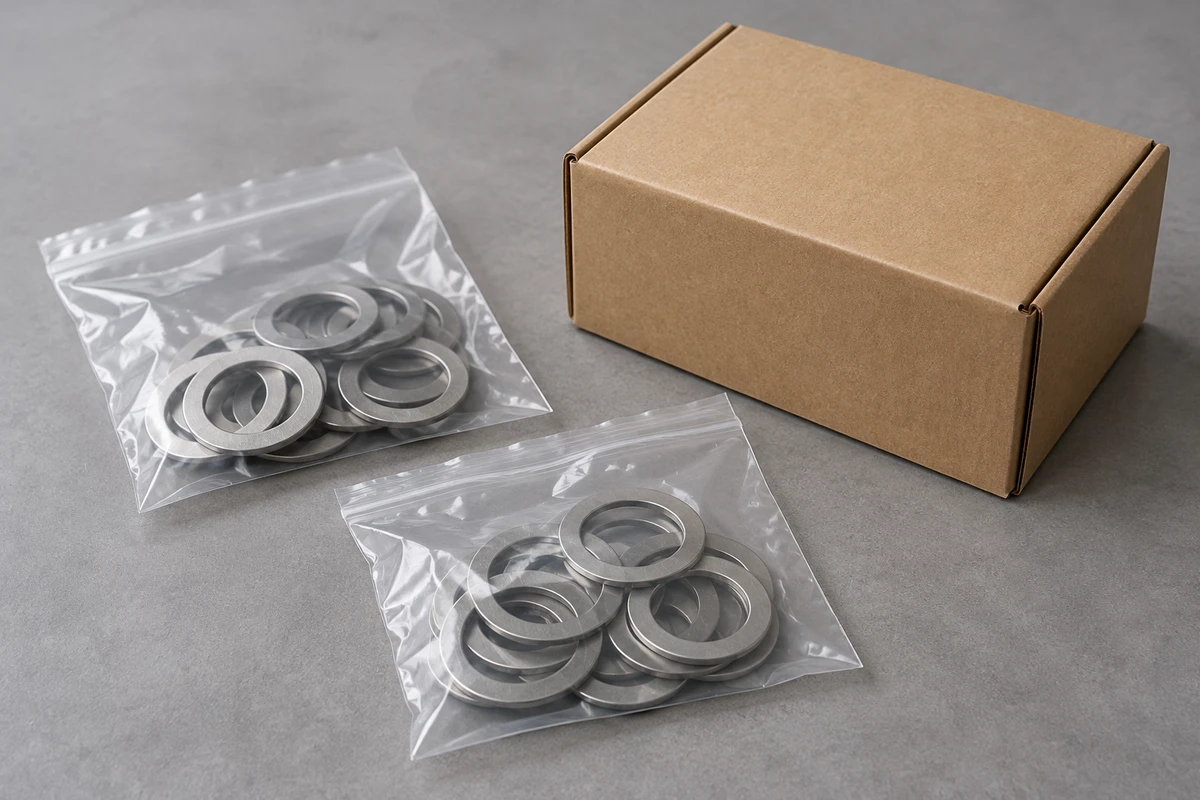
A VCR gasket purchase can retain the same product reference and outer quantity while changing what one factory bag supplies. Before copying a previous kitting instruction, reconcile the offered bag multiple with the pieces the kit is meant to contain. Otherwise an apparently unchanged order can produce a different allocation.
This question starts before receipt. It concerns the commercial package hierarchy in the offer, not a finding that a supplier delivered the wrong count. Product selection and any authority to open or divide protective packaging remain separate decisions.
Identify the changed level
Swagelok's notice headed VCR Gasket Packaging Improvements, effective Q2 2025, describes MTS standard VCR gasket packaging moving from ten pieces per bag to one hundred. It removes the intermediate insert-box level while retaining one thousand pieces per keg. The bag is identified as the order minimum and multiple. These are historical commercial package quantities for the notice's scope, not quantities to assign to every gasket. Swagelok change notice
Ask the seller to connect its offered SKU and package version to the applicable notice. The announcement is not confirmation of its current inventory. Neither a familiar keg description nor a product photograph settles which bag version the quotation covers.
If the seller offers mixed versions, request a separate quantity basis for each affected line. Do not average the bag sizes into a fictional standard pack. The buyer needs an offer that can be mapped to the actual kit requirement without guessing which version will arrive.
Recover what the kit instruction intended
An earlier instruction may say one factory bag per kit because that was a convenient expression of a particular piece allocation. Find out whether the buyer intended a piece count, an intact factory selling unit, or both. Those requirements can diverge after a package change.
Retain the original approved instruction beside the proposed revision. Do not silently replace the word bag with pieces and assume the supply remains equivalent. A piece-based allocation may require a different supply form, additional authorized work or a change in how kits are issued. The quotation must identify those consequences before the buyer selects an option.
A fixed outer total is useful for reconciling the offer, but it cannot preserve a changed inner allocation by itself. A plan can buy the expected aggregate quantity and still issue too much or too little to each kit if it carries forward an obsolete bag definition.
Compare offers on the same quantity basis
Use separate fields for the supplier's price unit and the buyer's kit allocation. Record whether a quoted unit means one piece, one factory bag or one outer unit, with the applicable composition. A low-looking bag price is not comparable until that composition is known.
| Review field | Information to retain |
|---|---|
| Exact item | Offered SKU and applicability of the change notice |
| Factory version | Seller's attributable description of the actual offer |
| Inner quantity | Pieces per bag and the quoted minimum or multiple |
| Outer quantity | Bags and pieces per outer unit, with obsolete levels removed |
| Kit requirement | Approved piece allocation and any intact-pack condition |
| Commercial response | Price unit, supported supply form and unresolved changes |
| Decision | Accepted revised schedule or a named outstanding exception |
This worksheet is an original purchasing aid. It does not authorize a warehouse to split bags or establish a technical gasket requirement.
Keep smaller pouches accurately described
A distributor may propose a smaller pouch to meet the buyer's desired allocation. Treat it as a separate supply proposal. It is not automatically the former factory packaging simply because its contents count resembles the old bag.
Ask who supplies the revised pouch, which product-specific permission supports the work and what identification will accompany it. If the necessary answer is missing, keep the proposal open. Do not instruct the packer to open the supplied bag as a shortcut to resolving the commercial mismatch.
A fictional legacy bag allocation
Imagine an invented order instruction that allocates one factory bag to each kit using an earlier bag definition. A new quotation references a changed bag multiple but the same outer total. The buyer first retrieves the approved piece requirement and any condition requiring intact factory packaging.
If the piece requirement is unchanged, the new bag-based instruction no longer expresses it. The buyer can ask for a supported alternative supply form or review a changed issue arrangement. Neither option is assumed available. If intact factory bags are the controlling requirement, the buyer must review the changed per-kit quantity explicitly rather than pretend the earlier allocation survives.
If the supplier cannot identify the offered version, no conversion can close the question. Request a corrected offer with an attributable package schedule. An already accepted order should be varied through its responsible owners; the public notice does not amend it automatically.
Carry the decision into the inquiry
Retain the accepted package schedule with the kit instruction so the next buyer does not reuse the outdated bag definition. The result is a documented quantity and supply-form choice, not a receiving count, product authentication or installation approval.
See machined-parts sourcing for product context and use the spare-parts inquiry to identify the old allocation and new offer. Named makers are documentary examples; our role is independent aftermarket and unbranded buying coordination and supplier negotiation, without brand affiliation or a promise to supply the named brand.
The initial inquiry supports an eligible marketplace HTTPS link, an 8–1200-character description or screenshots. It accepts up to five PNG, JPEG, WebP or GIF images, at most 10 MiB each and 20 MiB total. PDF, CAD and ZIP files need a separately agreed authorized exchange; the image field is not a technical-file portal.
Does an unchanged keg total preserve the old kit allocation?
No. An unchanged outer total does not preserve the meaning of a changed inner bag. Recover the approved piece allocation and any intact-factory-pack condition, then map the actual offered version to both requirements before approving the kit schedule.
Does the notice prove which version my seller has?
No. The historical change notice identifies a maker-declared transition within its stated scope. Ask the seller to identify the affected SKU, actual offered pack version and quantity basis; the notice itself is not an inventory confirmation.
Is a distributor-created smaller pouch the former factory pack?
Not automatically. A distributor-created pouch is a separate supply form with its own provider, authority and identification requirements. A similar piece count does not establish the former factory packaging or permission to divide a supplied bag.
Can a transition notice amend an already accepted order?
The notice does not itself amend the agreement. Retain the accepted order and have the responsible buyer and supplier resolve any proposed variation, including changed quantity units and supply form. Do not silently replace the previous bag definition.
Sources
Discuss a sourcing request related to this article.VCR Gasket Packs: Reconcile a Changed Bag Multiple Before Kitting