
Bearing Suffix 2RS and C3: Checks Before Ordering
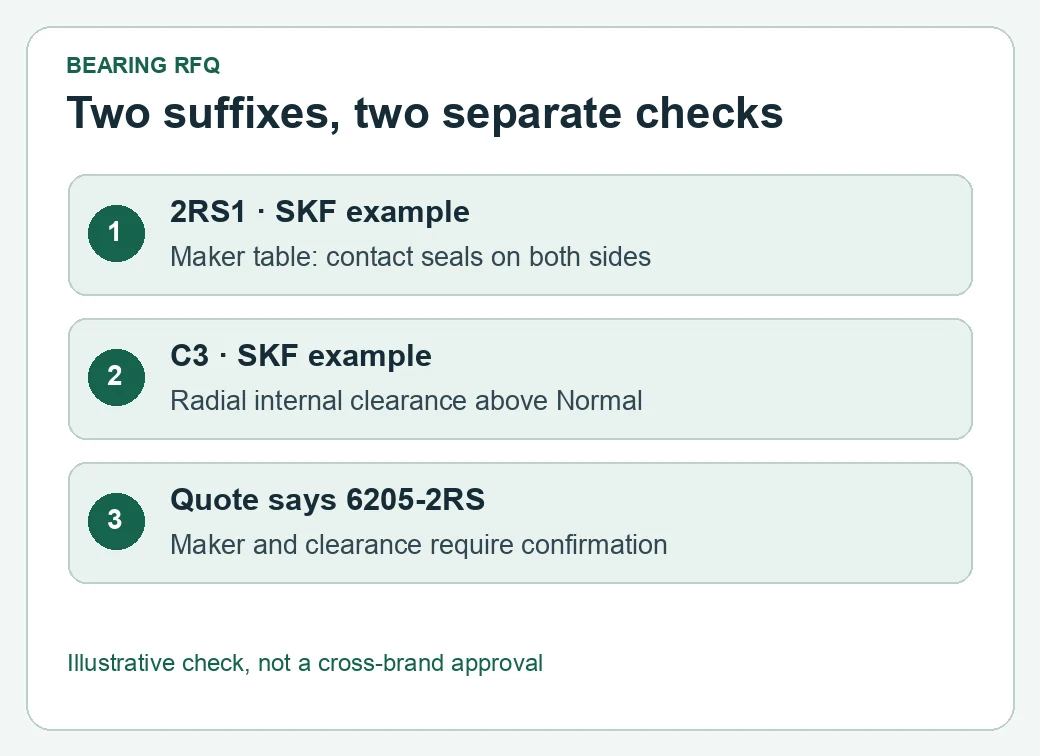
Check the marking as a complete maker-specific designation. Confirm the seals separately from the clearance class. SKF uses 2RS1 for two contact seals and C3 for radial internal clearance greater than Normal in the cited table.
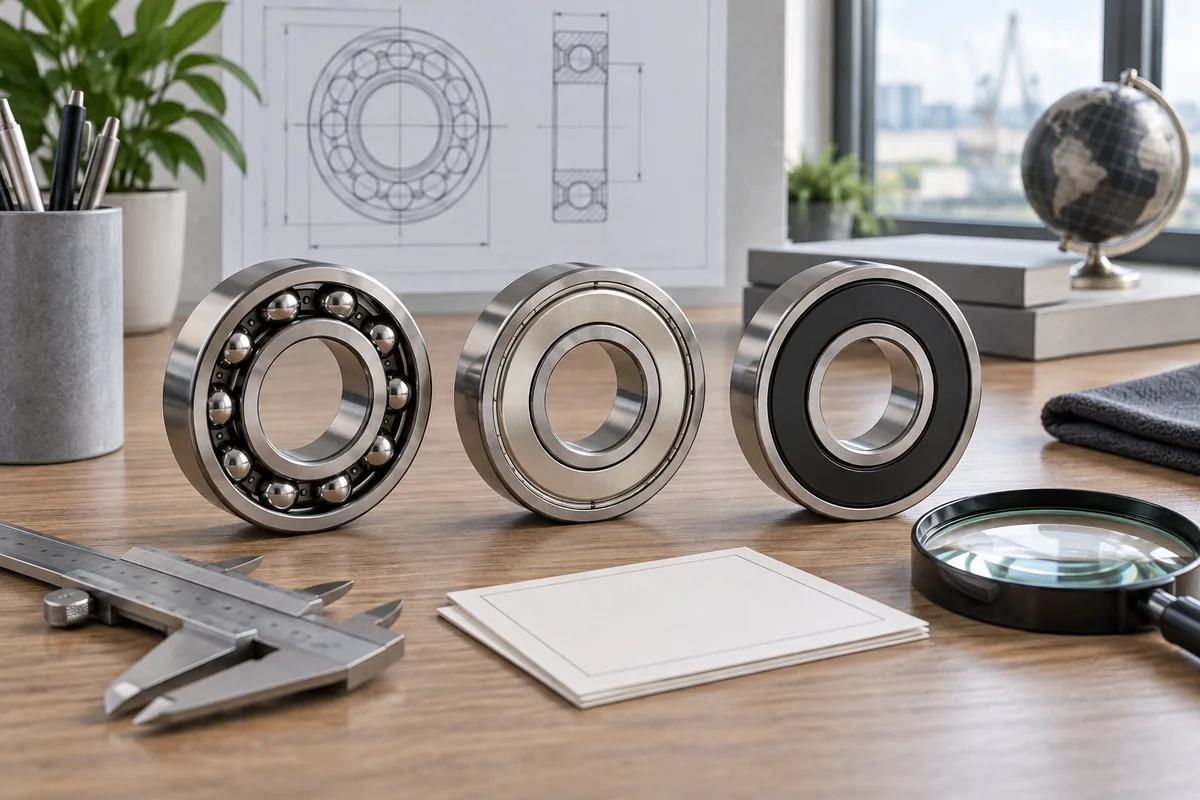
Hold a similar-looking bearing quote when suffixes differ
Illustrative receiving record: the buyer’s paperwork reads 6205-2RS1/C3 from SKF, but a quote says only “6205-2RS.” Leave the line pending. Ask for the offered maker and exact suffixes, a box or ring photo and the maker’s designation evidence. The remaining clearance field needs positive evidence before a substitute or reorder is considered.
- Base designation
- Record the complete marking and original maker. Compare the manufacturer’s dimensional table.
- Closure suffix
- Identify the type and side count from the offered maker’s table.
- Clearance code
- Record the explicit class. Confirm its application with the maintenance owner.
The SKF example explains two separate fields and does not establish an interchange rule across brands or applications.
When ordering a replacement bearing from a Chinese supplier, provide the complete designation and application record, not just the three dimensions or the first four digits of the model number. Include the manufacturer, every suffix and the bearing's position in the machine. If the seller proposes a different bearing, treat it as a substitution that needs a documented comparison and technical approval.
A match on bore, outside diameter and width is a good first filter, but it is not a complete specification. This tutorial helps you compile an identification package that a supplier can quote against. It does not choose a bearing arrangement or provide installation instructions.
Capture the old record before searching listings
Use the machine parts list, original purchase documentation or released maintenance specification, where available. Write down the OEM part reference, machine model and serial number, and the precise location of the bearing. The same machine may contain several bearings with different duties.
Take pictures of readable markings on the rings and, if retained, the original package. Write down the designation exactly as shown, preserving slashes, hyphens and suffixes. Clearly flag uncertain characters so the seller does not silently guess. Photograph the assembly location without dismantling equipment outside the site's approved maintenance procedure.
Differentiate between what you know and what you measured or deduced. A damaged bearing may have unreadable markings, and an earlier replacement may already differ from the original specification. Clearly indicate to your supplier the source for each field.
Read suffixes within the manufacturer's own system
Use the named manufacturer's documentation for that bearing family. NSK's motor-bearing catalogue separates series and bore information from seals or shields, internal clearance and grease information. For its listed nomenclature, C3 denotes clearance greater than CN; it is not a universal “better bearing” grade. NSK Industrial Motor Bearings.
A useful observed example is NSK 6301DDUC3. On 10 October 2026, the manufacturer's product record listed a 12 mm bore, 37 mm outside diameter and 12 mm width, with DDU contact rubber seals on both sides and C3 radial internal clearance. Those fields belong together. A listing headed only “6301 bearing” leaves the variant unresolved. NSK product record.
This example is not a recommendation for your machine. Do not apply one brand's suffix meaning to another without checking that brand's own catalogue. Do not infer suitability from a dimension match alone.
Prepare an identification table
Submit one table with the following fields:
- Required manufacturer and full designation, or “unconfirmed” where evidence is missing.
- OEM reference and source document, including revision where available.
- Machine model, serial number and bearing position.
- Bore, outside diameter and width, with units and the source of each value.
- Specified seals/shields, clearance, precision class, cage and lubrication details where documented.
- Known operating speed, loads, temperature and environment, identifying estimates as estimates.
- Quantity, destination, required date and acceptable evidence for product identity.
Do not back-fill missing application values with generic catalogue limits. Ask the responsible engineer or equipment maker to resolve important gaps. Request photos of the actual goods on offer and their packaging, tied to the designation in the quote, rather than a generic stock photo shared by multiple variants.
Put substitutions in a separate comparison
Ask the seller to present the required item and proposed item side by side. Compare full designations, documented dimensions, sealing, clearance, tolerances, lubrication and other properties relevant to the application. Require a source for each comparison, and specify who can approve the change.
An answer saying “same size, equivalent quality” does not resolve a changed seal or clearance specification. Conversely, a differently written suffix may be a genuine catalogue convention; it still needs a manufacturer-supported comparison. If the machine maker specifies a matched set or a proprietary assembly, raise that requirement before accepting an individual catalogue bearing.
Link price and timing to the approved item. A quick quote for an alternative whose technical suitability is still unresolved is not yet a usable recovery plan.
Check product identity and sourcing evidence separately
Ask for the selling entity, supply channel, invoice description, product markings and available manufacturer traceability. A catalogue PDF documents a product design, but it does not prove that the goods on offer are that product or that the seller is authorized.
For SKF-branded products, SKF recommends authorized distribution and offers manufacturer review of suspect goods using photographs and purchase evidence. Follow the named brand's current process when authenticity is uncertain. Attractive packaging or a buyer's visual comparison is insufficient evidence by itself. SKF brand protection guidance.
This draft does not assert that 1688SpareParts or any specific seller is an authorized distributor.
Copy this bearing RFQ
“Please quote the full manufacturer designation in the attached identification table. Confirm seals/shields, internal clearance and any other documented suffix requirements. Supply the product reference, photographs of the offered item and package, supply-channel information and available identity records. List any proposed substitute separately with a field-by-field technical comparison and supporting manufacturer documents. Do not remove suffixes or substitute the product without written approval. Quote quantity, packing, destination delivery scope and lead-time assumptions.”
On receipt, reconcile the order line, package and product markings under your agreed incoming procedure. Quarantine unresolved mismatches for review before release to installation. Use the supplier-check guide for the broader sourcing assessment, then submit your identification pack through the spare-parts quote page.
Put this guide to work
Working notes to adapt to your order. Keep the approved specification and the cited guidance alongside this sheet.
Use this worksheet when maintenance records, readable markings and a supplier's offered designation do not yet agree. It helps the buyer hand an identifiable question to the responsible engineer without turning uncertain characters or a dimension match into an approved replacement.
Review the bearing identification gaps
| Check | Record to keep | If unresolved |
|---|---|---|
| Keep the original transcription and its uncertainty visible. | The full marking as read, photographs where available, uncertain characters identified, and each field tagged as documented, measured or inferred. | Request the available source record or clarification. Leave an unreadable character unresolved instead of letting a search result complete the designation. |
| Link suffix interpretation to the named manufacturer and bearing family. | The relevant manufacturer reference alongside the documented seal, clearance and other requirements for the requested item. | Ask the responsible engineer or equipment maker to resolve the requirement; do not apply another brand's suffix meaning or fill application gaps with catalogue limits. |
| Separate the offered product's identity from the seller's supply-channel claim. | The quote designation, actual goods and package photographs, markings, selling entity and available supply-channel or traceability records. | State which identity or channel question remains open. A design catalogue or package photograph alone does not establish seller authorization or settle authenticity. |
| Give a proposed substitute its own technical decision. | Requested and offered designations compared field by field with manufacturer references, changed properties identified and a named approver's decision. | Keep the substitute separate from the requested order line and seek the missing comparison or approval. Do not merge it into the requirement because its dimensions match. |
| Keep incoming identity review connected to the approved order line. | The order description, received package and product markings, available lot identity records, and the recorded status of any mismatch. | Keep unresolved mismatches under the site's incoming controls and assign a reviewer before release to installation. |
Bearing identity and substitution review sheet
Use an evidence reference for each field and retain unknowns as unknowns. This record prepares a technical review; it does not select the bearing arrangement or provide installation instructions.
| Field | What to enter | Decision or handover |
|---|---|---|
| Requirement authority and machine position | [OEM/source reference], [Released requirement], [Machine/serial reference], [Bearing position] and [Responsible reviewer]. | Identify which requirement the quote must answer. Refer conflicting records to the responsible engineer rather than choosing the easiest designation to source. |
| Uncertain identification field | [Designation as read], [Uncertain character or field], [Photograph/document], [Documented/measured/inferred] and [Clarification owner]. | Request clarification with the original evidence attached. Preserve the uncertain entry until the source or responsible reviewer resolves it. |
| Requested item versus proposed item | [Requested manufacturer/designation], [Offered designation], [Changed field], [Manufacturer comparison reference] and [Approval/status]. | Keep the supplier's explanation distinct from technical approval. A suffix explanation does not by itself establish suitability for the machine position. |
| Goods identity and sourcing evidence | [Selling entity], [Goods/package photographs], [Markings/quote line], [Supply-channel record] and [Unresolved claim]. | Record separately what supports the product design, the identity of the offered goods and any authorization claim. Refer unresolved authenticity questions through the named brand's process. |
| Incoming mismatch and release status | [Approved order line], [Received identity/lot reference], [Observed mismatch], [Review owner] and [Release status]. | Reconcile the actual received item under the agreed incoming procedure. A supplier catalogue is not a record of the goods received or their release. |
Send engineering a specific bearing review request
Please review the bearing for machine position [POSITION]. The requested item [ITEM] comes from requirement record [REQUIREMENT], while the supplier offers [OFFER]. Uncertain identification fields are [UNKNOWNS]; the attached evidence is [IDENTIFICATION]. Proposed differences and manufacturer references are recorded at [COMPARISON]. Please have [APPROVER] resolve the requirement and record any substitution decision in [LOG]. Offered-goods and supply-channel evidence remain recorded separately at [IDENTITY]; this packet does not establish seller authorization or provide installation approval.
Sources
Discuss a sourcing request related to this article.Bearing Suffix 2RS and C3: Checks Before Ordering