
Jaw coupling kits: reconcile the selected variant’s parts schedule
Check the actual standard, spacer or taper-sleeve coupling schedule before a generic two-hub description becomes the dispatch contents list.
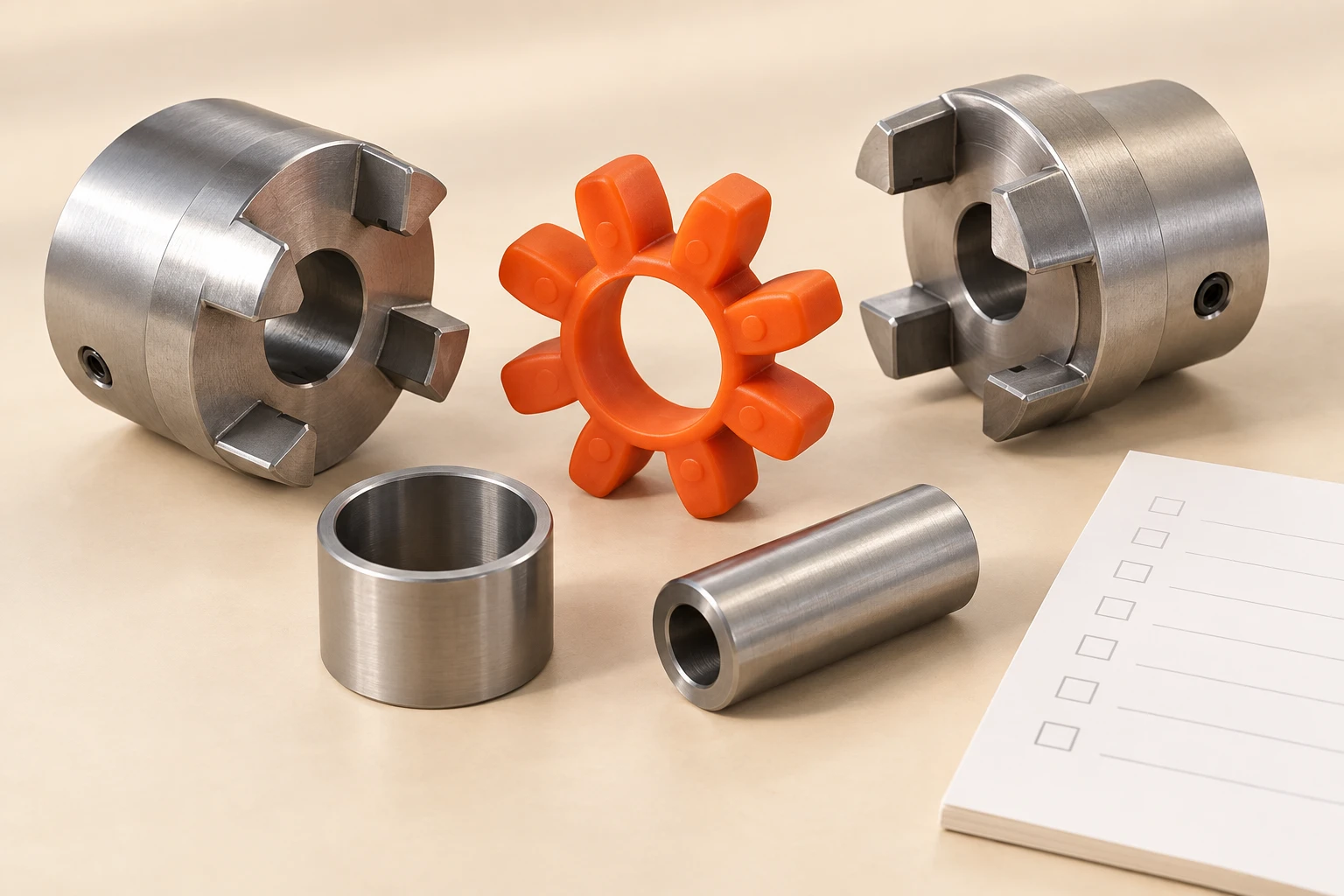
Two hubs do not define every jaw coupling kit. Once the coupling variant is approved, use its actual component schedule to review the supplied package. A generic two-hub title can conceal different elastic elements, spacer components or separately supplied sleeves and small parts.
This decision checks the kit against an already selected configuration. It does not choose hardness, approve a bore, prescribe assembly or declare that all similarly named couplings share one contents list.
Use the schedule for the selected construction
KTR's ROTEX instructions 40210 EN, edition 27 dated July 2025, explain that the coupling is generally supplied in individual parts. Their component schedules distinguish the standard shaft coupling, DKM and taper-clamping-sleeve constructions. The named lists differ; they are not a universal bill of materials for other products. KTR ROTEX instructions, sections 3.2 and 4.1
Ask the actual supplier for the exact approved construction, size and schedule issue. Retain any order-specific configuration qualifications. A family brochure can locate the product while leaving the purchased variant unresolved.
Use the provider's component terminology. If an offer shortens a spacer coupling to coupling set, ask it to identify the referenced construction and included groups. Do not reconstruct the list from an illustration of a standard version.
Reconcile components before counting packages
For each entry in the accepted schedule, record whether it is included in this dispatch, supplied separately, intentionally excluded under the order or still unanswered. Keep an exclusion linked to the accepted scope rather than accepting a new omission under a packing note.
Expand small-part descriptions enough to identify what the provider actually owes. Assorted screws or accessories does not establish the specific scheduled items. Conversely, do not add hardware merely because a different maker's example lists it.
Distinguish the physical package quantity from the coupling quantity. Individual parts may be shipped in more than one inner group, or several coupling units may share an outer carton. Neither arrangement changes the approved component requirement.
Keep separately supplied sleeves visible
If the selected construction includes separately identified sleeves, ask whether the actual quote and dispatch include them. A hub described as suitable for a sleeve does not by itself establish that the sleeve is supplied. The same principle applies to a separately identified spacer or elastic element in the approved schedule.
Document which supplier or order line provides each separately purchased group and where the complete kit is expected to be accounted for. Do not assume that an existing warehouse item is available, compatible or allocated merely because its generic name matches.
A missing required group should remain a specific completion issue. The buyer can consider the actual provider's partial-dispatch proposal, but the packing list should not label the resulting supply complete until its defined scope is satisfied.
A fictional standard-list substitution
Suppose an accepted order identifies a spacer construction. The supplier's dispatch sheet uses a saved standard-coupling template showing two hubs and one elastic element. The sheet omits the selected construction's separate spacer-related entries.
The buyer should compare the sheet with the actual approved schedule and ask whether this is a paperwork error, a changed offer or a supply gap. The title alone cannot distinguish those explanations. No component should be added or removed by the packer to make the box resemble a generic photograph.
If the supplier supplies a corrected list but an item remains deferred, preserve that status and seek the buyer's specific dispatch decision. A corrected document establishes the intended contents; it does not prove all physical items are present.
Use a variant-to-pack checklist
| Record field | Evidence to retain |
|---|---|
| Selected construction | Approved coupling family, size, variant and schedule issue |
| Scheduled group | Every actual component entry, using provider terminology |
| Supply status | Included, separate, accepted exclusion or unresolved |
| Separate order | Source and allocation of sleeves, spacers or other separately purchased groups |
| Package mapping | Inner/outer references tied to each complete ordered unit |
| Completion decision | Document correction, supply gap or authorized partial dispatch distinguished |
This worksheet is a purchase-scope method. It does not set hardware dimensions, torque, alignment or component interchangeability.
Close the kit at the agreed variant
Retain the selected construction and schedule issue with the final pack declaration. A later construction substitution requires the appropriate product approval before the pack record can adopt it. An unchanged coupling family name should not conceal that change.
The completed record answers whether the declared supply accounts for the approved kit. It does not establish machining quality, spider material, condition or machine suitability; those questions retain their own evidence and responsible reviewers.
Bring the specific packing question into the inquiry
Use the Machined parts category and Spareparts sourcing request to identify the approved item and exact proposed change. The site provides independent aftermarket/unbranded buying coordination and supplier negotiation. Manufacturer examples do not establish affiliation, original-equipment supply, specialist packing capability or engineering approval.
The initial form supports an eligible marketplace HTTPS link, an 8–1200-character description or screenshots. It accepts up to five PNG, JPEG, WebP or GIF images, at most 10 MiB each and 20 MiB combined. PDF, CAD and ZIP files need a separately agreed authorized exchange; the image field is not a technical-file portal.
Do two hubs and a spider always make a complete coupling kit?
No. Use the selected construction’s actual schedule. The named KTR variants demonstrate why a standard list cannot define every kit.
Does a hub for a taper sleeve include the sleeve?
Only the actual supplied scope answers that. Keep the hub and any separately identified sleeve line visible in the quotation and dispatch record.
Can a photograph replace the parts schedule?
A photo may support identification but cannot establish the exact variant’s included and excluded groups. Request the governing schedule.
Does a corrected pack list prove physical completeness?
No. It clarifies declared scope. Actual supply and any deferred items still need the agreed completion evidence.
Sources
Discuss a sourcing request related to this article.Jaw coupling kits: reconcile the selected variant’s parts schedule