
Mechanical Seal Face and Seat Materials: RFQ Checks
Request a material pair for the primary face and mating seat, and list secondary sealing materials separately. Tie each code and position to the offered configuration and the target duty.
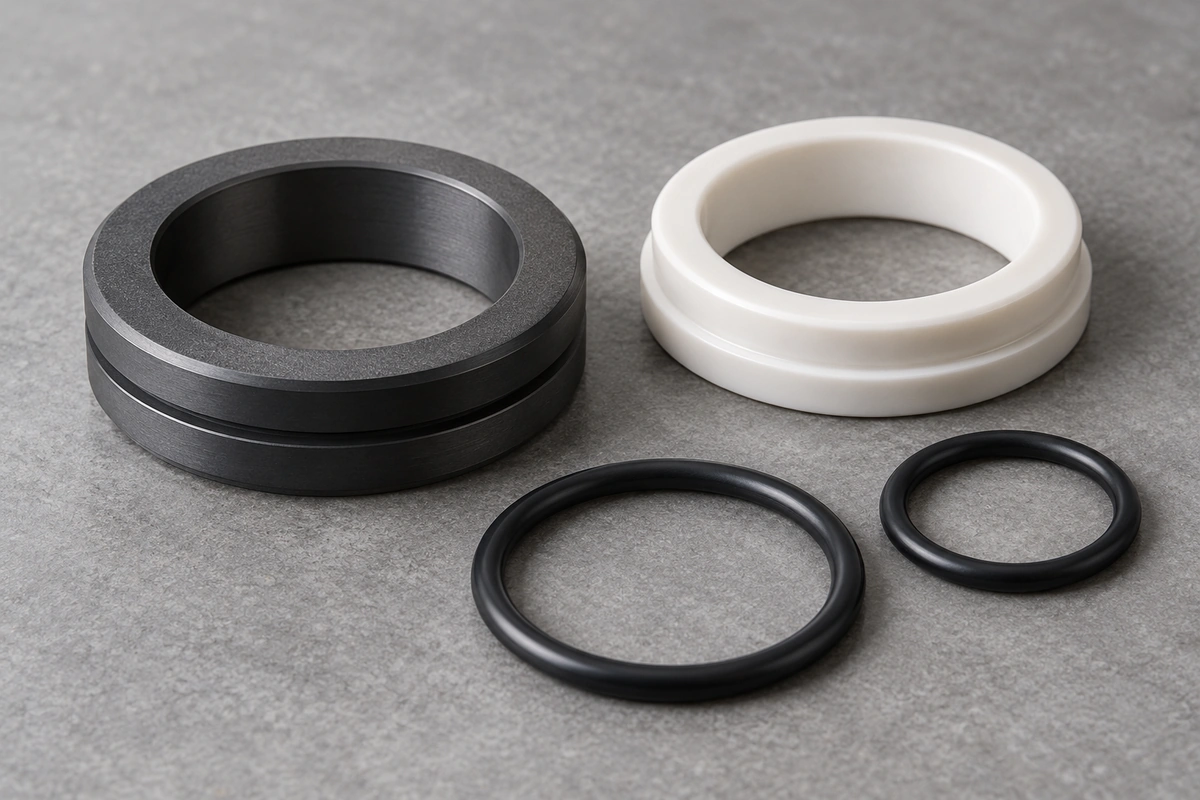
Match every material to its position before approval
Illustrative comparison: one quotation says “carbon and SiC”; a second names a carbon primary ring, SiC mating ring and a secondary seal code. Mark the first as incomplete. Ask both suppliers to identify the governing drawing, face/seat roles and secondary seal material, then request engineering confirmation against the fluid composition, operating range and rotation.
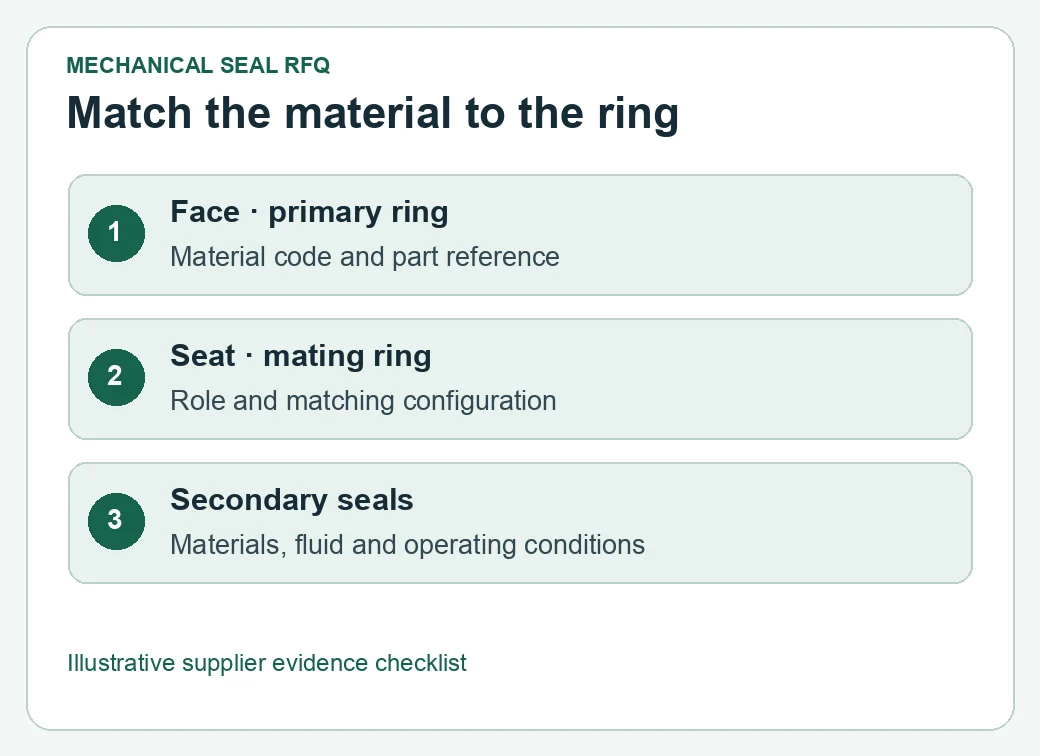
- Primary face
- Record exact material/code, ring role and part reference on the drawing.
- Mating seat
- Record the specified material, location and offered pairing.
- Secondary seals and duty
- List each secondary seal or bellows material and the intended fluid, pressure, temperature and rotation.
The John Crane reference shows separate primary and mating ring roles on its own model. It does not certify the materials or operating limits of a different quotation.
A mechanical seal described as “carbon ceramic” or “silicon carbide” still leaves an important question: which component is made from which material? The purchasing record needs a component-by-component answer, including the secondary seals. A prominent face-material claim should not conceal an unspecified elastomer or a different stationary seat.
Start with the approved seal assembly identity, equipment reference and service record. Keep dimensional fit, material selection and actual supply contents as separate decisions. A material map makes the quotation reviewable; it does not certify compatibility with the process.
Use component labels before material codes
EagleBurgmann's BT-AR page lists seal-face, seat, elastomer and metal-part materials separately. Its component illustrations also distinguish rotating elements from the stationary seat and associated gasket. This named product illustrates component-specific documentation; it is not a cross-reference for an unidentified seal. EagleBurgmann BT-AR
Ask the supplier to map its offered materials to the same component roles used in the applicable drawing. If its terminology differs, request an annotated component list. Do not assume that a letter appearing in one manufacturer's face-material table has the same meaning in its elastomer table, another product family or another manufacturer's system.
For secondary seals, ask which elements the declaration covers. A statement about the rotating bellows does not necessarily identify a stationary gasket. If a seal kit contains several elastomer items, each should be linked to the relevant specification or a clearly defined common material declaration.
Keep the approved combination intact
The requirement may specify a particular face-and-seat combination rather than independent choices from two menus. Preserve that combination in the RFQ. A supplier should not choose a familiar seat simply because it stocks the requested rotating-face material.
Likewise, retain the exact compound or grade information present in the released specification. Where the record gives only a broad polymer name, flag that limitation for technical review rather than inventing a formulation. The responsible specialist should define what evidence is needed for the documented medium, operating conditions and any applicable product-contact requirement.
Do not copy a general product-family approval into the offered combination. The BT-AR page itself qualifies material approvals by type and combination. If an approval is needed, request evidence for the exact proposed configuration and intended use; a logo beside a product family is not the complete answer.
Resolve seat alternatives explicitly
Ask whether the quoted price includes the stationary seat and its gasket, only the rotating portion, or a complete defined assembly. A seller may use one product photograph for several supply options. Require itemized identifiers so the material map and commercial scope refer to the same goods.
If an alternative seat is proposed, give it its own line with its geometry, material and supporting drawing reference. Do not merge it into the original requirement under “equivalent seal.” A technical reviewer may accept a supported alternative, but the purchasing record must preserve that decision and its boundaries.
A fictional partial material answer
A buyer requests a documented face, seat and secondary-seal combination. Offer A confirms the face material and shaft size but says only “rubber” for the secondary seals. Offer B identifies all components but proposes a different seat material. Neither is an unqualified match.
Ask A for the missing compound declarations tied to the assembly. Route B as a substitution with the supplier's evidence, not as a completed confirmation. These invented offers show different open questions; they do not rank materials or prescribe a service combination.
Make the material map reusable
| Record field | What the buyer should preserve |
|---|---|
| Seal family | Manufacturer, exact assembly identifier and component drawing revision |
| Rotating face | Material designation mapped to the rotating face, not the whole seal |
| Stationary seat | Seat variant, material and included gasket identified separately |
| Secondary seal compound | Each bellows, O-ring or gasket linked to the required declaration |
| Documented service | Approved application record and unresolved compatibility questions |
| Approved combination | Decision for the complete proposed material combination and supply scope |
Retain the map with the quotation and order, including the supplier's document revision. If an offered component changes, reopen the affected combination review rather than updating the price line alone.
Send a component-specific inquiry
“Please identify the offered rotating face, stationary seat and every secondary-seal material against our referenced assembly. State exactly what is included. List alternative seats or material combinations separately with their supporting documentation and unresolved service questions.”
Use the seals and gaskets category and spare-parts inquiry to organize the request. Independent purchasing coordination does not establish manufacturer affiliation, genuine-product status or engineering acceptance of the seal.
The inquiry image field accepts up to five PNG, JPEG, WebP or GIF files, no more than 10 MiB each and 20 MiB combined. A supported marketplace link, a short description or screenshots can start the request. It is not a PDF, CAD or ZIP upload field; arrange other technical files through a separately agreed, authorized exchange.
Does “silicon carbide seal” identify the entire material combination?
No. Ask which component uses that material and obtain separate declarations for the mating seat, secondary seals and other specified parts.
Can I decode a material letter using another manufacturer’s table?
No universal mapping is established. Use the exact maker’s documentation for the relevant product and component role.
Does the price necessarily include the stationary seat?
No. Require the quote to identify the rotating portion, stationary seat, gasket and any other included items explicitly.
Does a product-family approval cover every material option?
Do not assume so. Ask for applicable evidence for the exact type, material combination and intended use, then obtain the responsible review.
Sources
Discuss a sourcing request related to this article.Mechanical Seal Face and Seat Materials: RFQ Checks