
Retaining ring receipt: clarify gap-end finishing
Separate a retaining ring gap-end concern from its circumferential finish and confirm the deburring scope actually ordered.
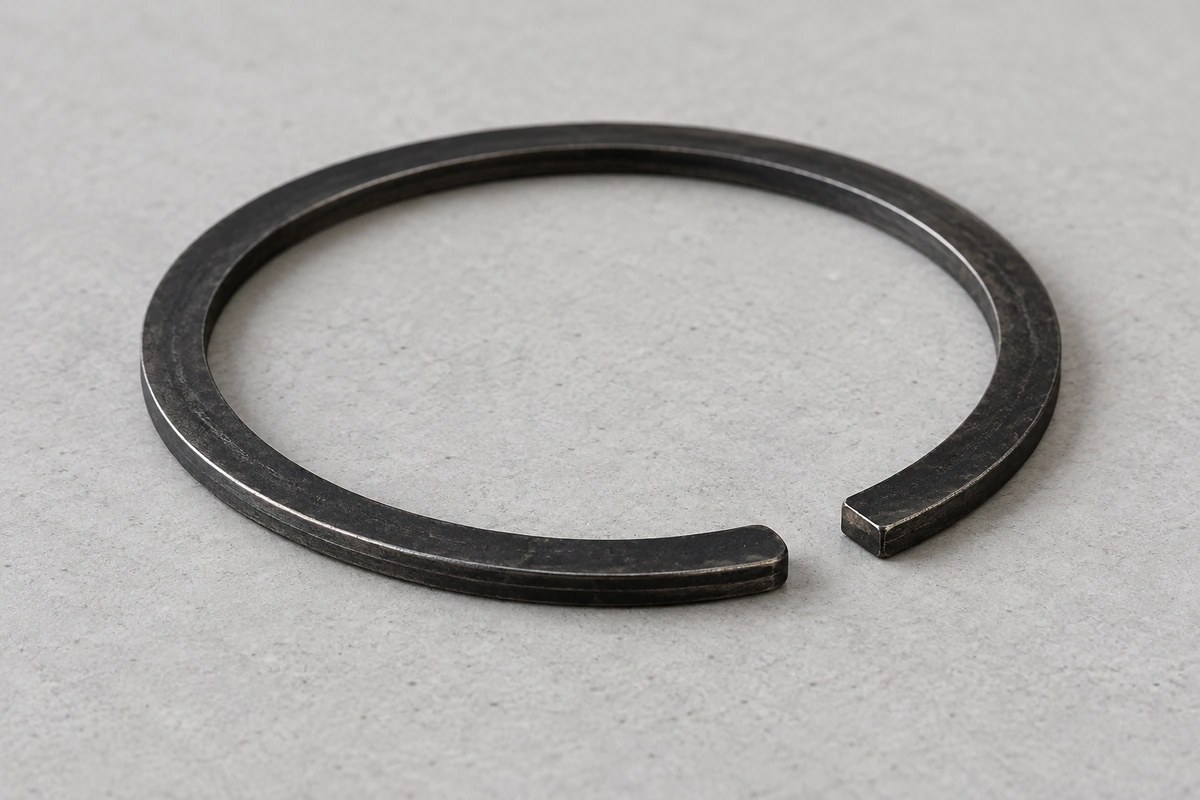
A retaining ring can have smooth circumferential edges while leaving a different concern at its gap ends. When receiving reports a cut-end corner, ask which finishing requirement applies at that location. “The ring is smooth” is too broad an answer, but a visible corner alone is not a justified rejection criterion either.
The decision concerns the finishing scope delivered at the gap ends. Shaft or housing selection, groove geometry and retention capacity remain separate technical questions.
Name the location before the defect
Smalley’s finishing page distinguishes its smooth circumferential surfaces from sharp corners that can occur at gap ends after cut-off. It describes vibratory or hand deburring to meet specifications. This supports a location-specific purchasing question; it does not set a universal edge limit or instruct receiving personnel to deburr parts. Smalley material finishes
Use existing attributable images or the original inspection record to identify the reported end. Preserve the observation wording. “Corner visible at gap end” is a record of a concern; “unsafe burr” or “acceptable cut edge” requires an appropriate assessment. Do not ask someone to run a finger over an edge or flex the ring to create evidence.
Recover the ordered end treatment
Read the accepted drawing, finishing notes and supplier acknowledgement. Find out whether deburring was specified for the gap ends, generally specified with a governing definition, explicitly excluded, or never resolved. A marketplace phrase such as “smooth finish” may not answer this distinction.
Ask the supplier to identify the finishing operation it declares for the received lot, and how its response addresses the agreed requirement. A process name is not itself a result for each ring. If the order requires edge evidence, keep the delivered inspection or other agreed evidence connected to the relevant pieces and location.
Do not treat a clarification as permission to create a stricter edge specification after delivery. Where the requirement is missing, the buyer and technical owner must settle the next scope honestly. A commercial negotiation about added finishing is different from a documented failure to perform already agreed work.
Keep a gap-end finishing record
| Field | Specific record |
|---|---|
| Ring identity | Family, order line and received population |
| Concern location | Gap-end reference and original image/report, distinct from the circumference |
| Requirement | Accepted finishing note, drawing revision and any unresolved definition |
| Declared operation | Supplier’s lot-linked finishing statement |
| Delivered evidence | Record addressing the specified end condition, with coverage limits |
| Next decision | Clarification, qualified assessment or separately agreed remedy |
This original worksheet does not specify an edge radius, acceptance class or inspection technique. It makes the missing contractual and technical answers easier to distinguish.
A fictional smooth-circumference reply
A fictional order includes a drawing note requiring a defined gap-end finish. An incoming image raises a concern at one end, but the supplier responds with a close-up of a different circumferential region and says the surface is smooth.
Retain that image for the region it shows. Ask for the evidence addressing the named gap-end requirement and actual received population. Do not expand the concern to every ring without support. If the supplier instead confirms that the operation was omitted, preserve that admission separately from the reviewer’s assessment of the parts.
A proposed local touch-up needs its own authorized scope, competent provider and subsequent evidence. The receiving article does not grant permission for hand finishing. Close only the specific end-finish question after the responsible decision, leaving groove compatibility and retention duty under their original review.
Prepare a bounded supplier question
Use the Machined parts category and Spareparts sourcing request to identify the item and the unresolved question. Independent aftermarket or unbranded buying coordination does not establish manufacturer affiliation, original-equipment supply, inspection availability or technical approval. The manufacturer references above explain documentation; the fictional example is not a customer case.
The form supports a supported-marketplace HTTPS link, an 8–1200-character description, or screenshots. It accepts up to five PNG, JPEG, WebP or GIF images, at most 10 MiB each and 20 MiB combined. It does not accept PDF, CAD or ZIP uploads. Arrange other authorized technical files only through a separately agreed exchange.
Does a smooth ring circumference settle a gap-end concern?
No. Keep the end location separate and request the evidence for the finishing requirement that applies there.
Is gap-end deburring always included?
No universal inclusion is established here. Check the accepted order, drawing and supplier acknowledgement for the actual finishing scope.
Can receiving remove the corner before documenting it?
This article provides no finishing authorization. Preserve the original record and obtain a competent, agreed remedy plan if further work is needed.
What if no edge criterion was agreed?
Record the missing definition and request technical and commercial clarification. Do not present a newly chosen limit as an original contract term.
Sources
Discuss a sourcing request related to this article.Retaining ring receipt: clarify gap-end finishing