
Mixed seal kits: keep metal treatments outside the seal contact plan
Map elastomer, metal and preservative contacts before accepting one outer kit, without assuming that a separator proves compatibility.
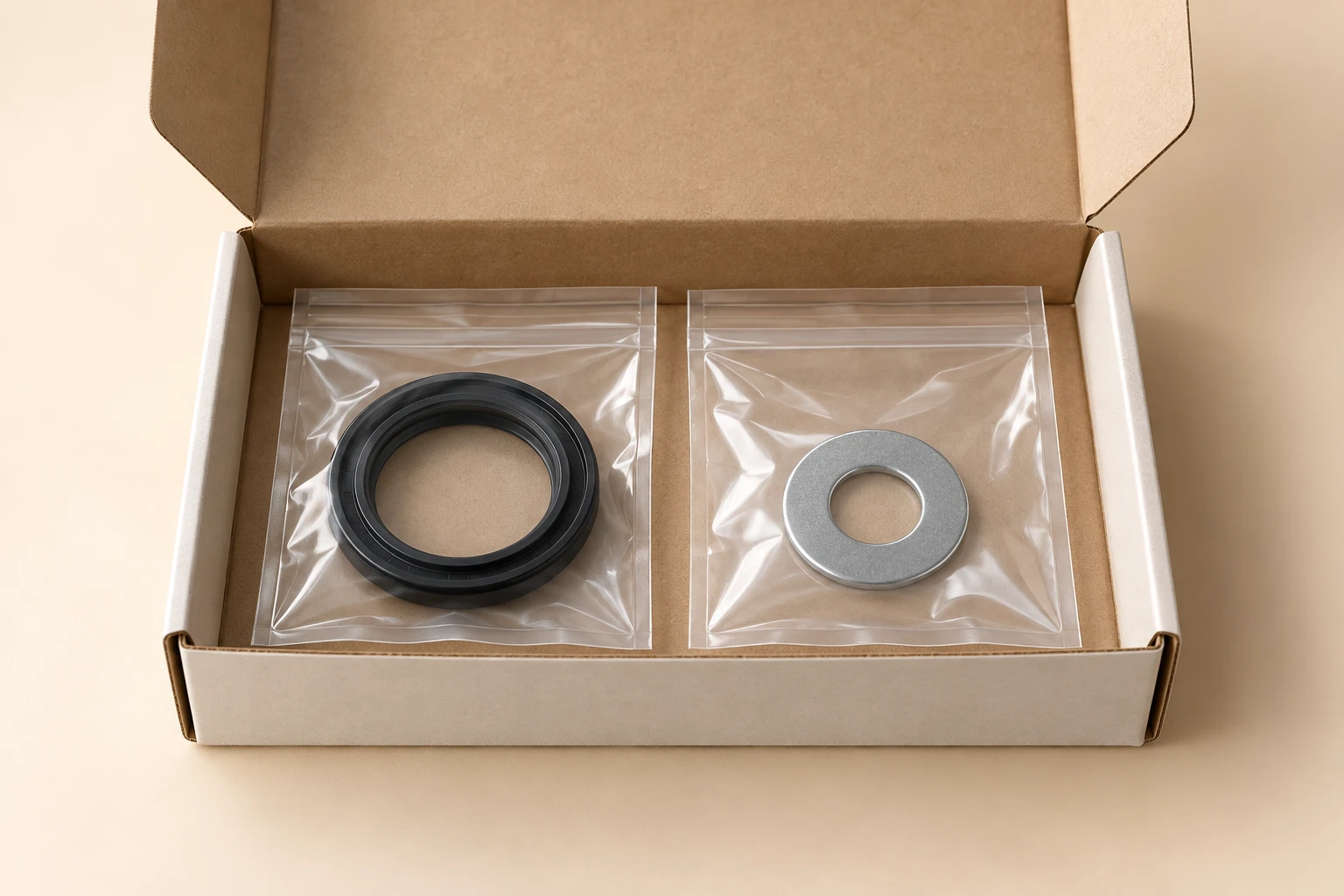
One outer kit can contain an elastomer seal and a metal companion while leaving their inner contact requirements unresolved. Before accepting a combined layout, identify what is allowed to touch the seal, including treatments carried by the metal item. Counting the right components does not answer that question.
Begin with the components already selected. This review decides whether the proposed inner arrangement has a supported contact basis. It does not choose a seal compound, prescribe a cleaning method or assess an unexplained film found after delivery.
Map more than the two solid components
Hallite's storage guidance distinguishes deformation, contact with liquids and semi-solids, contact with certain metals, and contact with other non-metallic materials. Its liquid-contact guidance includes an exception for items packed that way by their manufacturer. These are bounded reasons to examine the proposed contact arrangement rather than assume all kit materials can share one enclosure. Hallite storage of seals, sections 5–8
For the actual kit, identify the seal's documented compound, the metal item and any declared preservative or other treatment. A description of the metal alone leaves the treatment unspecified. A seal material declaration alone leaves the other side of the contact unspecified.
Ask whether the original manufacturer package remains intact or the proposal exposes the seal to new neighboring materials. Preserve the original packing reference where available. Do not extend a maker-packed exception to a seller's later addition of an unidentified oil, grease or other material.
Give each inner relationship its own answer
List the proposed direct contacts and the separation intended between groups. An inner pouch may separate two solid surfaces while leaving questions about its own material and closure. Obtain the exact proposed construction and the responsible provider's applicable assessment rather than declaring any paper or plastic a universal solution.
Keep the metal-preservation requirement visible too. A packing correction should not silently remove an ordered treatment from the metal item to simplify the kit. Request a proposal that addresses both component requirements and identifies any unresolved conflict for their technical owners.
The outer kit reference can link the separately supported inner groups. That administrative relationship does not require the contents to touch, nor does it establish that a particular inner layout is available. Ask the supplier to show what it is actually proposing and which part of the arrangement its evidence covers.
Review a fictional washer-and-seal combination
Imagine a released kit containing a seal and a preserved metal washer. The proposed drawing places them loose in one small pouch. The supplier confirms the washer material and says the preservative is standard, but provides no treatment identity.
The buyer has enough information to locate the gap, without diagnosing damage. Ask for the treatment declaration and a contact proposal covering the identified seal compound. If the supplier proposes separate inner packages, obtain their references and the relevant support for that arrangement. Two bags in a picture are a proposal, not a compatibility result.
Now suppose the supplier's evidence applies to the seal's original closed package, while the new layout removes that package. The evidence and proposal concern different states. Keep the original package boundary explicit and request a response for the actual revision before accepting the change.
Use a contact-domain record
| Record field | Evidence to retain |
|---|---|
| Seal side | Exact seal and compound declaration, plus original package state |
| Metal side | Companion reference and actual declared surface treatment |
| New contact | Which proposed interfaces change when the kit is formed |
| Inner separation | Exact package construction and proposal revision |
| Applicability | Provider evidence covering the actual materials and intended conditions |
| Outer association | Kit reference retaining each inner group and unresolved decision |
This worksheet is an original purchasing aid. It helps the buyer keep the seal, metal treatment and separator questions together without inventing a test or a material prescription.
Preserve the accepted boundary during kit changes
A later change of metal preservative, seal compound, inner pouch or layout needs an applicability check by the responsible owner. The same outer box and total count do not establish that the previous contact decision still applies.
Close the packaging question only to the extent supported: identified components, declared treatments, reviewed inner arrangement and any remaining uncertainty. If fluid is already found on delivered seals, preserve that condition and route it for a separate assessment. A prospective kit layout cannot retrospectively approve an unknown exposure.
Bring the specific packing question into the inquiry
Use the Seals and gaskets category and Spareparts sourcing request to identify the approved item and exact proposed change. The site provides independent aftermarket/unbranded buying coordination and supplier negotiation. Manufacturer examples do not establish affiliation, original-equipment supply, specialist packing capability or engineering approval.
The initial form supports an eligible marketplace HTTPS link, an 8–1200-character description or screenshots. It accepts up to five PNG, JPEG, WebP or GIF images, at most 10 MiB each and 20 MiB combined. PDF, CAD and ZIP files need a separately agreed authorized exchange; the image field is not a technical-file portal.
Can seals and metal parts share an outer kit?
The outer association alone does not decide the inner contacts. Obtain a supported arrangement for the actual components, treatments and packaging materials.
Does a manufacturer-packed oil exception cover later repacking?
Do not assume it does. Identify who applied the material and which product-specific evidence covers the changed state.
Is any plastic bag a sufficient separator?
No universal separator is selected here. Request the actual construction and evidence for the contact arrangement rather than approving a material family name.
Should metal preservative be removed to simplify the kit?
This article authorizes no removal or cleaning. Preserve the metal requirement and ask the responsible providers to resolve the combined packaging proposal.
Sources
Discuss a sourcing request related to this article.Mixed seal kits: keep metal treatments outside the seal contact plan