
Laminar-seal RFQ: quote the complete ring arrangement
Separate ring count, turns and supply grouping so a loose laminar ring is not mistaken for the documented labyrinth arrangement.
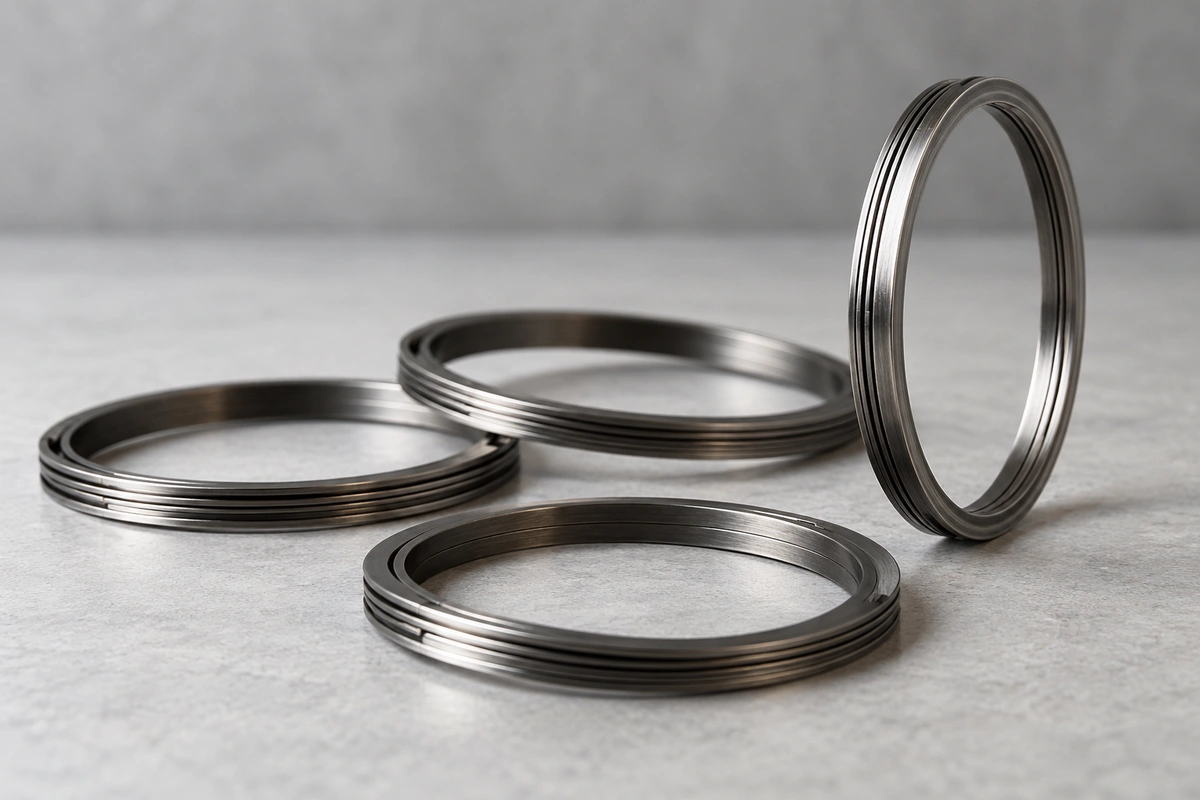
An order for “one laminar seal” can mean one loose ring, a set of rings or the components for a complete documented arrangement. Resolve that unit before comparing quotations. The buyer needs a supply response to the approved labyrinth arrangement, not merely a nominal diameter and a photograph of a coiled ring.
This purchasing decision is different from choosing a retaining ring for axial retention. A shared ring-like appearance does not establish the same function, arrangement or acceptance requirements.
Distinguish a ring from the arrangement it belongs to
Smalley describes a laminar seal as a metallic labyrinth using multiple rings in a groove, with arrangement and orientation determined by the application. Its configuration example separately identifies the number of rings and the turns in each ring. That distinction supports a clear bill of materials; it is not a universal stack to copy. Smalley laminar seal rings
Keep ring count and turns in different fields. A multi-turn ring is not automatically a multi-ring set. A seller's word “double” needs the relevant product designation and definition before it can answer either field.
The source also does not establish that an arbitrary arrangement is gas-tight or suitable as a pressure boundary. Do not convert a labyrinth description into a pressure-containment claim in the RFQ or order.
Recover the arrangement drawing
Begin with the approved assembly drawing and its revision. Identify every ring family, location and quantity referenced by that drawing. Preserve groove references and any orientation information as document references for the technical reviewer; do not create assembly instructions from a sample or catalogue illustration.
An as-found group of rings may be incomplete or may reflect an earlier modification. Record what was observed separately from what the approved bill of materials requires. If the record is missing, request engineering clarification instead of assuming the number of recovered pieces is the intended count.
Ask whether the manufacturer supports the proposed replacement designation for the exact arrangement. A cross-reference may help identify a candidate, but the buyer should retain the source and its limits rather than generalize an interchange statement across unrelated products.
Define the commercial unit without losing component identity
The quotation should state the price unit, number of rings per unit and each ring's exact designation. If the seller supplies matched or grouped sets, ask how those sets are identified and whether the package count corresponds to the required assembly count.
Keep optional spare rings separate from the quantity needed for the specified arrangement. Otherwise a package containing extra pieces can hide an incomplete or different set. Ask the supplier to map its contents to the drawing's item numbers rather than simply confirming a total weight.
For a proposed change of ring family, number of turns or grouping, request an explicit deviation. Do not let the seller adjust the arrangement to suit a convenient pack size. The engineering owner must determine whether the change is acceptable.
A fictional “two-turn” misunderstanding
A released arrangement calls for multiple identified rings, while a supplier quotes “one two-turn ring.” The buyer reads “two-turn” as confirmation of the required number of rings. The quote actually answers a different quantity field.
Return the offer for a bill-of-materials mapping: how many physical rings, of which designations, are supplied per quoted unit? Keep the arrangement unresolved until the response matches the approved record and the technical review is complete. This example recommends no ring count or orientation.
Use an arrangement-scope worksheet
| Record field | What the buyer should preserve |
|---|---|
| Arrangement drawing | Approved labyrinth assembly reference and revision |
| Ring family | Required and proposed manufacturer designation for every drawing item |
| Ring count and turns | Physical ring quantity separated from turns per ring |
| Groove references | Drawing identifiers connecting rings to their documented locations |
| Supply grouping | Pieces or sets per quotation unit, with optional spares separate |
| Engineering confirmation | Accepted arrangement and any family, count or grouping deviation |
At receipt, the agreed packaging and identity record can help reconcile ring counts and designations. It cannot prove the labyrinth's performance in service. Any technical acceptance activity needs its own approved scope.
Ask for the drawing-based set
“Please quote the complete ring contents listed in our arrangement drawing. State each ring designation, ring count, turns and supply grouping separately. Identify any changed family or quantity as a deviation, and do not infer the required arrangement from the nominal diameter alone.”
Use the machined-parts category and spare-parts inquiry to start the request. Application-specific arrangement and orientation remain with the responsible engineer and manufacturer documentation, not a marketplace title.
The inquiry image field accepts up to five PNG, JPEG, WebP or GIF files, no more than 10 MiB each and 20 MiB combined. A supported marketplace link, a short description or screenshots can start the request. It is not a PDF, CAD or ZIP upload field; arrange other technical files through a separately agreed, authorized exchange.
Does a two-turn ring mean two rings are supplied?
No. Turns and physical ring count are different fields. Require the supplier to state both and identify the quotation unit.
Can I copy a manufacturer’s illustrated ring stack?
Not as a universal arrangement. Use the approved application drawing and obtain competent review of the exact proposed set.
Does a metallic labyrinth description prove pressure containment?
No. Do not infer gas-tightness or pressure-boundary suitability from this product description or worksheet.
Are the rings recovered from an old assembly a complete specification?
They are as-found evidence. Compare them with the approved arrangement and resolve missing pieces, wear or previous changes through the responsible technical owner.
Sources
Discuss a sourcing request related to this article.Laminar-seal RFQ: quote the complete ring arrangement